
Let’s talk high performance mixing
Mixing is a randomization process that attempts to get all ingredients into a direct mathematical ratio to each other. Results can be measured in several ways (see our Consumer’s Guide).
When possible, several samples are compared for variance among them. A Standard Deviation and Coefficient of Variation (Cv.) is calculated using standard statistical formulas. A Cv. of 5% is the measurement from the mean and considered nearly perfect.
Segregation: the main enemy
Studies show that in particles over 50 micron, a size differential of 20% will create a roll-apart effect. Particle size cannot be controlled this closely, so it is the number one enemy.
Particle weight can also cause problems in smaller particles, or when the weight exceeds the mixer’s capability. In our mixers, this limit occurs around 300 lb. per cu. ft. or a Specific Gravity of 5.
The speed of mixing is a major factor to overcome segregation, because mixing must be faster than segregation forces can act to achieve an accurate mixture.
Other factors that challenge mixing include sifting, electrostatic charge, sticky ingredients, and lumps.
Sampling and sample sizes
The sample size must be large enough to mathematically contain the smallest number of particles and allow proper analysis. It should not exceed the actual amount of material to be used. For example, if one cup of detergent is used, the sample should not be larger than one cup.
We don’t believe in using big samples, cutting and grinding them smaller, and then testing. Grinding is also mixing, so the result reflects both the mixer and the grinder.
Sampling is always somewhat inaccurate. Simply scooping from the top is usually as good as any method. Sampling correction factors can make numbers look good, but the real value is questionable.
What is high performance mixing?
- Mixing free-flowing materials to Cv. 5% in 10–60 seconds in small samples.
- Providing solutions when ingredients are not free-flowing.
- Overcoming segregation caused by particle size and weight.
- Ability to predict, repeat, and reliably deliver results.
- Mixing without degradation or heat generation.
- Accurate addition of liquids.
- Savings in minor ingredients.
- Applying shear when needed.
- High-quality machines rated to work 99.8% of the time.
- High-volume production from the same or less floor space.
- Lower cost per ton, more profits, and faster ROI for the user.
How does PHLAUER® work?
Fast, accurate, high performance mixing requires organized transport and void space for particles to randomly change places with no dead spots.
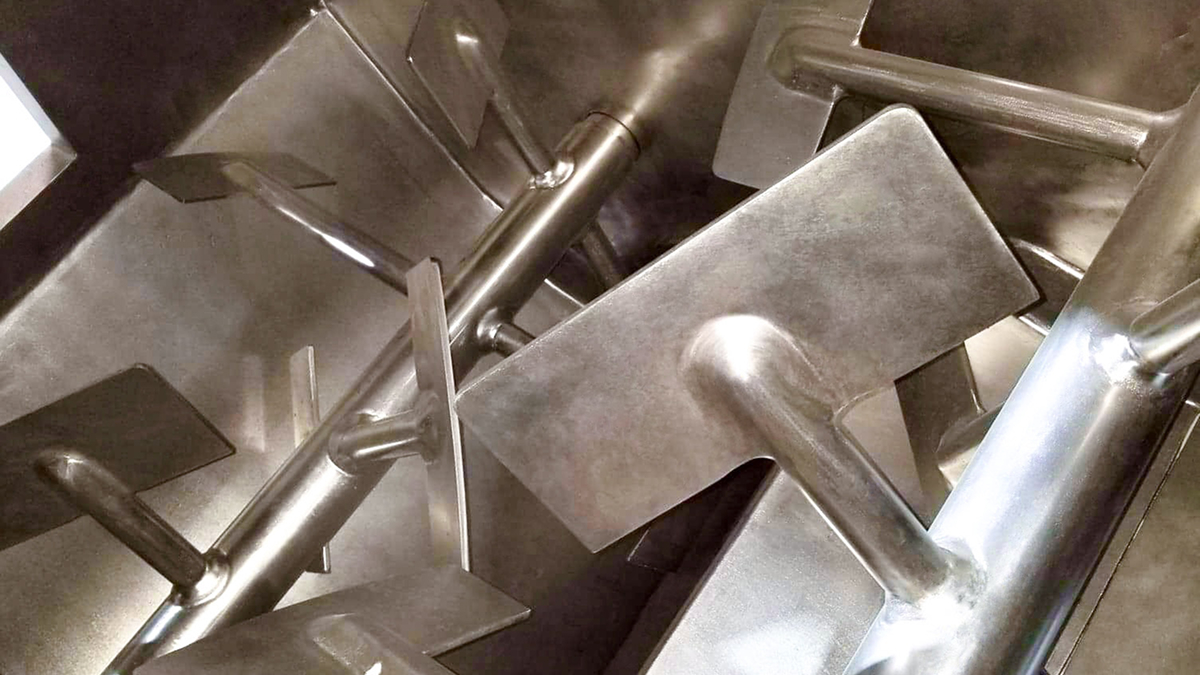
Our patented rotor is a paddle system with at least 12 paddles turning at a slow speed of 300 feet per minute (1.5 m/s) on the periphery. Half of the paddles direct material toward one end, and half toward the opposite end, providing continuous transport.
The paddles mechanically create voids and then direct material to randomly fill them. The system is fully balanced so all particles are within reach of the rotor. Loading can happen anywhere.
Each mixer has paddles sized to ensure no zone serviced by two paddles exceeds 10” (250 mm), minimizing segregation. The number of paddles is unlimited, keeping all particles in motion with no dead spots.
Void creation is determined empirically, varying from 1.8 to 0.67 times the batch volume per rotor revolution. This high particle movement ensures many opportunities for repositioning.
This particle motion makes the rotor ideal for adding liquids and pairing with Shearmakers.